
1.7 KiB
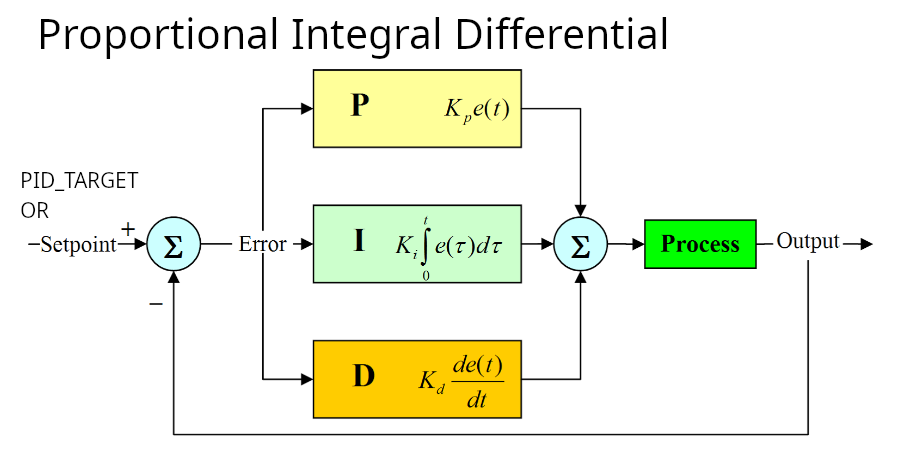
!
My recipe
Adjust the proportional until about 90% on target. Add in integral until very minor overshoot. Add derivative if too much overshoot.
PID controller explained
Proportional Control (P)
The difference between the planned PID_TARGET and the actual process variable is known as the current error value, and the proportional component of a PID controller generates an output that is exactly proportionate to this value. The proportionate reaction will be large if the mistake is significant, and vice versa. The sensitivity of the controller to the mistake is determined by the proportional gain (Kp). But P control by itself is unable to get rid of the steady-state error, which results in a permanent offset.
Integral Control (I)
The steady-state error is eliminated by the integral component, which gradually accumulates the error and modifies the controller’s output. The mistake is added up over time and then multiplied by the integral gain (Ki). By ensuring that the total error is pushed to zero, whatever offset that the proportional control may have left behind is eliminated. On the other hand, instability and oscillations might result from excessive integral activity.
The integral term often needs limits in practice.
Derivative Control (D)
Based on its rate of change, the derivative component forecasts the inaccuracy in the future. By increasing the derivative gain (Kd) by the error’s derivative over time, it produces a damping effect. By doing this, the response is smoothed down and oscillations and overshoot are lessened. Derivative control, however, is susceptible to error signal noise and, if mishandled, may intensify it.
Often the derivative in not used.