
1.4 KiB
Single Pole Op-AMP low pass Buffer
Note: This is a low pass amplifier/buffer. At high frequencies it has an effective gain of one. If this is used as an amplifier it will have an effect of not amplifying the higher frequencies. Hence low pass buffer, not low pass filter!
!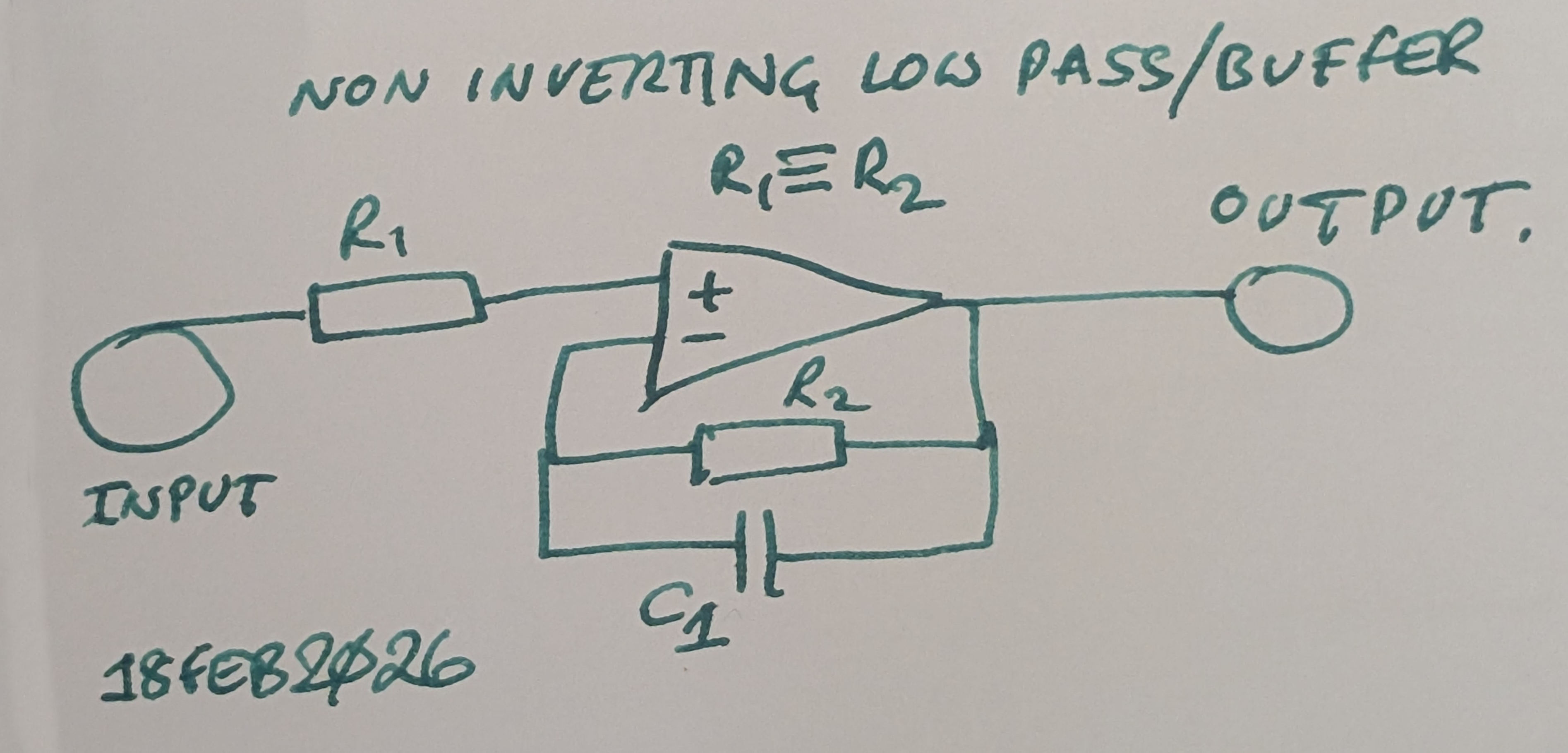 A single buffer op-amp, with
 R_1 to
plus and R_2 as feedback, with a parallel feedback resistor, will act as a low pass filter with a 3Db cut-off point at,
f_c = \frac{1}{2.\pi.R_2.C} \; .The gain of the filter effect at frequency f where the cut-off is f_c is
|H| = \frac{1}{\sqrt{1+(\frac{f}{f_c})^2} + 1}Note this is a single pole filter with a characteristic, past f_c of
** Every ×10 increase in frequency → –20 dB
** Every ×2 increase in frequency → –6 dB
But in this case its drop off from the Gain of the amplifier. High frequencies will have a theoretical lowest gain of one.
A double pole actual low pass filter configuration is the Sallen Key.
Example
If R_1, R_2 are 22k and the capactor C_1 is 1nF the 3Db point will be
\frac{1}{2 \times \pi\times22E3\times1E-9} = 7.2E3At 10 Mhz lets calculate the attenuation:-0=
|H| = \frac{1}{\sqrt{1 +(\frac{10E6}{7.2E3})^2}} = \frac{1}{1388.9} = 720E{-6}Converting this to Amplitude \; Db i.e. 20 log_{10} (|H|) giving $-62.8 Db$
!